

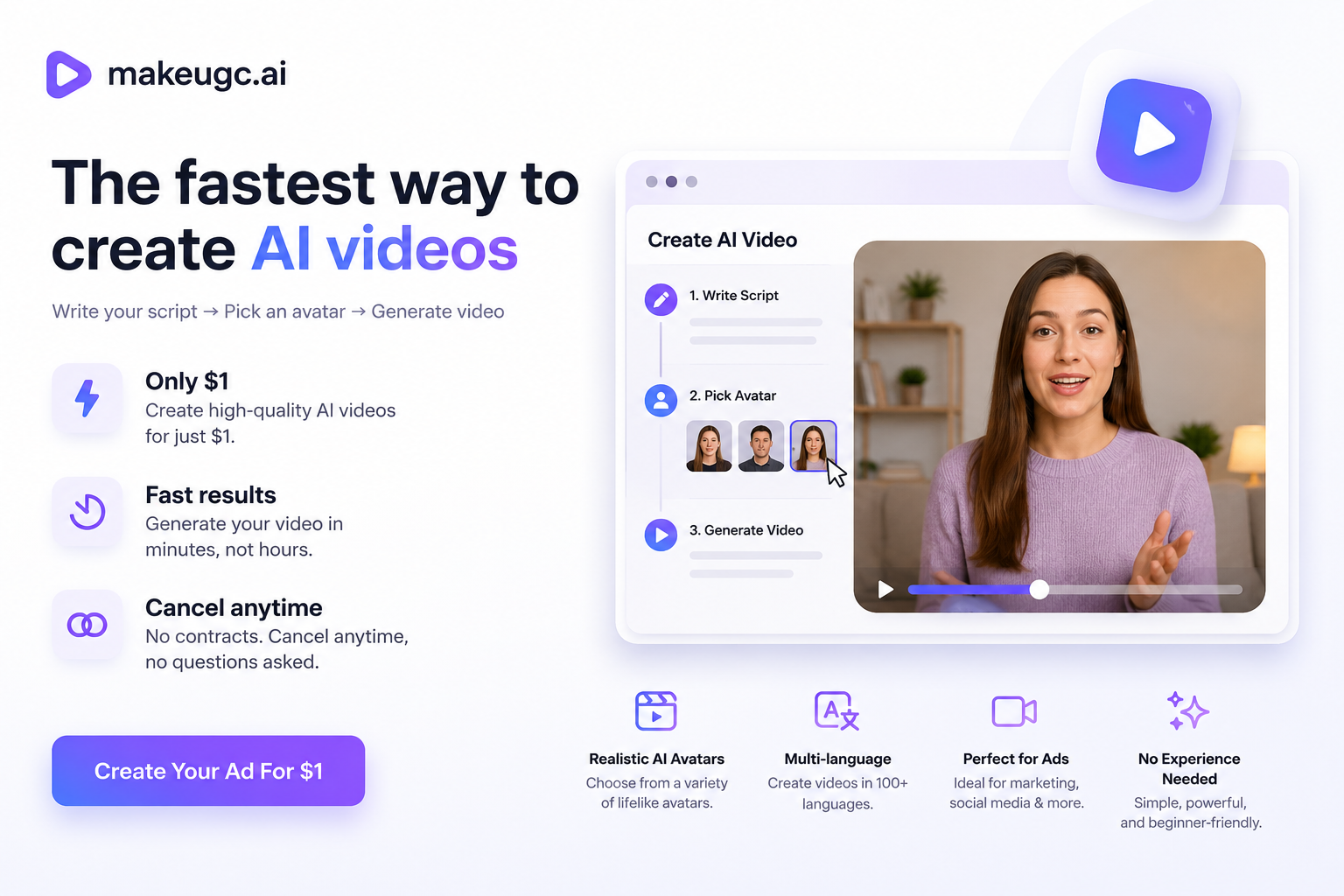
A year ago, most brands still depended heavily on real creators for UGC ads.
Now in 2026?
AI-generated UGC is everywhere.
TikTok ads, Shopify product videos, Instagram Reels, even Amazon product promos are increasingly using AI avatars and AI spokesperson videos to test marketing angles faster and cheaper than traditional content production.
That’s exactly where platforms like MakeUGC AI entered the market.
The promise sounds almost too good:
- Generate UGC-style ads in minutes
- Use AI avatars instead of hiring creators
- Scale TikTok creatives faster
- Save thousands on production costs
- Create multiple ad variations instantly
Naturally, a lot of marketers became skeptical.
Because honestly?
Most AI UGC tools still look fake.
The voices feel robotic. Facial movement looks unnatural. And many AI ads completely destroy the “trust factor” that makes real UGC work in the first place.
So the real question is:
Is MakeUGC actually useful, or is it just another overhyped AI video generator?
After researching customer reviews, Reddit discussions, pricing, features, and real user experiences, here’s the honest answer.
Quick Verdict
| Category | Rating |
|---|---|
| Ease of Use | 8.7/10 |
| Video Speed | 9/10 |
| AI Avatar Quality | 7.8/10 |
| Ad Testing Potential | 8.8/10 |
| Realism | 7.4/10 |
| Value for Money | 8.3/10 |
| Overall Score | 8.2/10 |
Final Verdict: 8.2/10
MakeUGC works best as a fast AI creative testing tool, not a perfect replacement for real creators.
If your goal is:
- Testing hooks quickly
- Scaling TikTok ad creatives
- Producing large amounts of short-form content
- Reducing production costs
…then the platform honestly makes a lot of sense.
But if you expect flawless human realism indistinguishable from real UGC creators, you may still notice limitations.
And that’s true for almost every AI UGC platform in 2026.
MakeUGC AI is an AI-powered platform designed to create UGC-style marketing videos using AI avatars, voiceovers, and automated video generation.
The platform focuses heavily on:
- TikTok-style ads
- Product promo videos
- AI spokesperson videos
- Short-form social media content
- E-commerce creatives
According to the company, the platform includes:
- 500+ AI creators
- 50+ supported languages
- Product-in-hand AI videos
- Bulk content generation
- AI image ads
- B-roll generation
- AI talking avatars
One of the biggest selling points is speed.
Instead of waiting days for creators, filming, editing, and revisions, marketers can generate multiple ad variations in minutes.
The reason is simple:
Modern brands need an insane amount of content.
TikTok, Reels, and YouTube Shorts reward constant testing and fresh creatives.
Many businesses now need:
- 20–50 short videos monthly
- Multiple hooks
- Different creators
- Constant ad testing
Traditional UGC production becomes expensive very quickly.
That’s why AI UGC exploded in popularity across e-commerce and affiliate marketing communities.
Instead of paying creators hundreds of dollars per video, brands can test ideas instantly using AI-generated content.
And for top-of-funnel advertising?
That speed can genuinely matter.
This is where the platform surprised many users.
The strongest advantage is not “perfect realism.”
It’s workflow efficiency.
Users consistently mention that MakeUGC helps:
- Generate creative variations quickly
- Test ad hooks faster
- Produce content at scale
- Reduce production bottlenecks
- Launch campaigns faster
Several users also praised the platform’s speed and creator workflow.
One reviewer described it as:
“Gold for the price after the learning curve.”
That honestly feels accurate.
Most AI tools require experimentation before getting high-quality outputs consistently.
Here’s the reality most AI marketers won’t openly admit:
AI UGC still struggles with trust.
On Reddit, many marketers repeatedly mention the same issue:
- AI videos can grab attention
- But real humans still convert better emotionally
That distinction matters a lot.
AI UGC performs best for:
- Hook testing
- Creative iteration
- Fast experimentation
- Awareness campaigns
- Ad angle testing
But when buyers need strong emotional trust?
Real creators still usually outperform AI avatars.
Even experienced marketers say the smartest strategy is often:
- Use AI UGC to test winning concepts
- Scale winners later using real creators
And honestly, that’s probably the best way to approach MakeUGC in 2026.
The reviews online feel mixed — which actually makes them more believable.
Positive feedback often mentions:
- Fast video generation
- Easy workflow
- Helpful creative tools
- Good for ad testing
- Affordable compared to competitors
However, negative reviews mainly focus on:
- Billing complaints
- Subscription cancellation frustration
- AI realism limitations
- Customer support response delays
On Trustpilot, the platform currently holds a mixed reputation with both highly positive and highly critical experiences reported by users.
That’s important to know before subscribing.
Compared to hiring real creators?
Honestly, no.
The platform offers relatively affordable entry pricing compared to traditional UGC production or some higher-end competitors.
For marketers constantly testing creatives, the cost savings can become significant.
Especially for:
- Dropshipping brands
- Affiliate marketers
- TikTok advertisers
- Shopify stores
- Small agencies
The real value comes from speed and testing volume.
Not necessarily from perfect realism.
Pros
Extremely Fast Content Production
Much faster than traditional UGC workflows.
Great for Ad Testing
Perfect for testing hooks, angles, and creatives quickly.
Lower Production Costs
Can save significant money compared to creator-based workflows.
Beginner-Friendly
The interface feels relatively simple for non-editors.
Massive Content Scaling Potential
Useful for brands producing high-volume short-form content.
Cons
AI Still Doesn’t Feel Fully Human
Some videos still look noticeably AI-generated.
Mixed Billing Reviews
Several customers reported subscription cancellation frustrations.
Learning Curve Exists
Better outputs usually require experimentation and testing.
Real UGC Still Converts Better in Some Niches
Especially emotional or trust-heavy products.
MakeUGC makes the most sense for:
- TikTok advertisers
- Shopify stores
- Dropshippers
- Affiliate marketers
- Performance marketers
- Agencies testing large ad volumes
Especially if speed matters more than perfect realism.
You may struggle with MakeUGC if:
- You expect flawless human realism
- Your niche depends heavily on emotional trust
- You dislike AI-generated aesthetics
- You want completely hands-off automation
For many marketers, yes.
Not because AI UGC completely replaces real creators.
But because it dramatically speeds up creative testing.
And in modern paid advertising, speed matters.
The brands winning on TikTok and Meta right now are usually the ones testing:
- More hooks
- More creatives
- More angles
- More variations
AI UGC helps make that possible at scale.
That’s why platforms like MakeUGC continue growing even while AI-generated content still has imperfections.
Final Thoughts
A lot of people misunderstand AI UGC.
The goal is not always to replace humans entirely.
The real advantage is:
- Faster testing
- Faster iteration
- Lower content costs
- More creative volume
And honestly?
That alone can massively improve ad performance for many brands.
MakeUGC AI is probably best viewed as a powerful creative testing tool rather than a magical “one-click viral video machine.”
If you approach it with realistic expectations, it can absolutely become a valuable part of a modern content marketing workflow.
FAQ
Is MakeUGC AI beginner-friendly?
Yes. Most users find the platform relatively easy to learn, though creating better outputs may require experimentation.
Can AI UGC replace real creators?
Not completely. AI UGC works very well for testing and scaling content, but real creators still often build stronger emotional trust.
Is MakeUGC good for TikTok ads?
Yes. The platform is heavily optimized for short-form social content and ad creatives.
Does MakeUGC create realistic videos?
The quality is improving quickly, but some outputs may still feel noticeably AI-generated depending on the script and avatar.
Is MakeUGC worth the price?
For marketers producing large amounts of content or testing many ad variations, the pricing can be very cost-effective compared to traditional UGC production.
Disclaimer
This article is for informational and educational purposes only. Experiences with AI marketing tools may vary depending on workflow, creative strategy, niche, and content expectations.